Trade Idea: SILJ/JPM


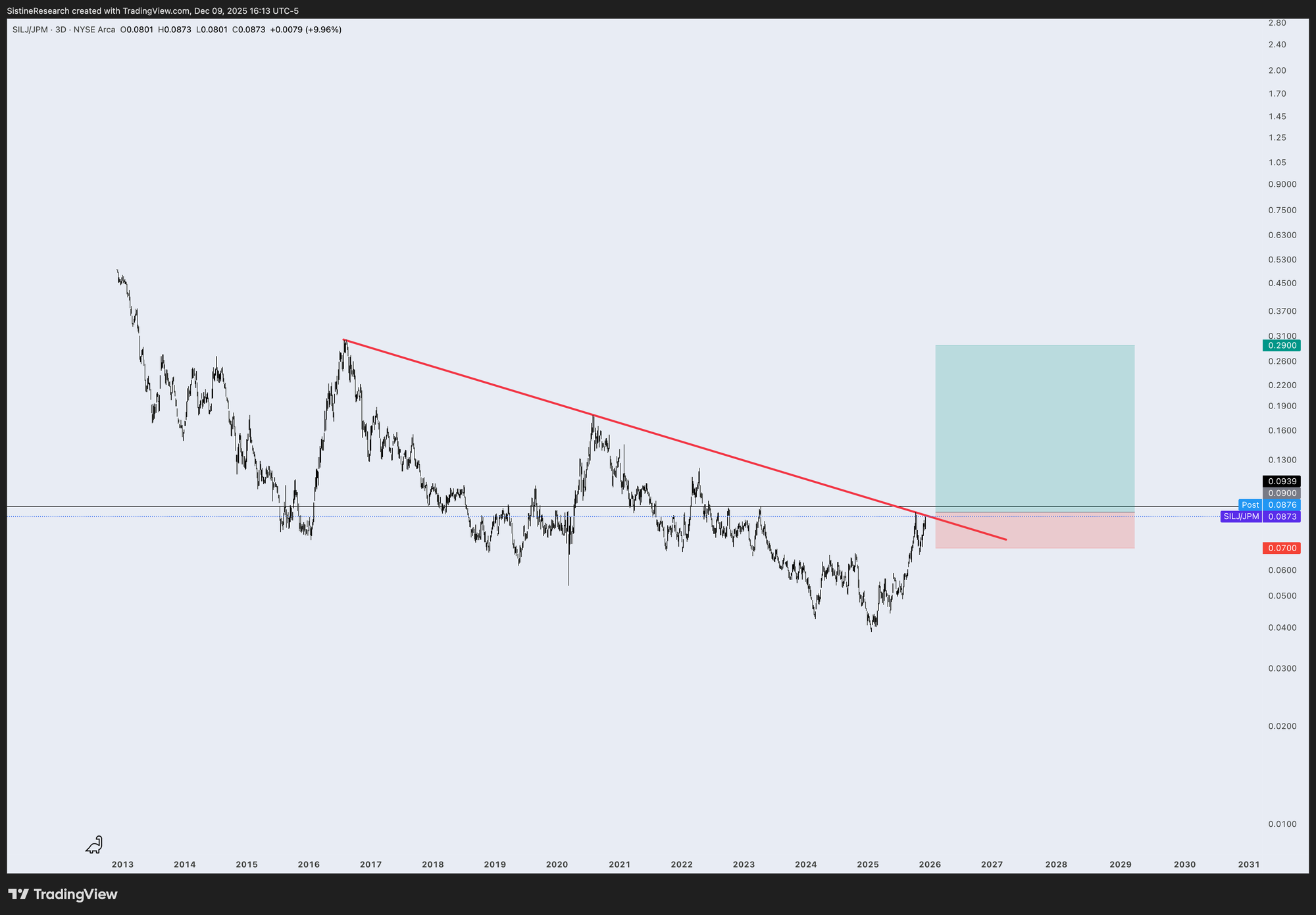
🏷️ Name: Amplify Junior Silver Miners ETF and JPMorgan
💠 Ticker: $SILJ and $JPM
📈 Direction: Pair trade: long SILJ, short JPM
🎯 Entry: 0.09
🎯 Target: 0.29
🛑 Stop Loss: 0.07
⚖️ Risk / Reward: 10: 1
Note: On pair trades make sure to chart the assets against each other (SILJ/JPM) to calculate the appropriate levels.
Strategic Thesis: The Great Silver Dislocation Arbitrage
Executive Summary
This thesis capitalizes on the structural decoupling between the physical silver market and the "paper" derivatives market. With silver spot prices reaching $61.23/oz (+4.8%) and the futures curve entering historic backwardation, the market signals acute physical scarcity.
The strategy pairs a Long SILJ position—offering unhedged operational leverage to rising silver prices—with a Short JPM position. The short leg targets the vulnerability of the bullion bank model, which relies on "paper" liquidity that is rapidly evaporating. While JPMorgan’s insolvency risk is mitigated by its balance sheet, the "blow up" thesis rests on the potential rupture of the paper-to-physical peg, which would severely impair the bank’s precious metals trading revenues and expose it to liquidity shocks on its $309 billion derivative book.
1. Macro Catalyst: The Breaking of the Paper Market
The foundational premise is the breakdown of the mechanism banks use to price silver.
- Deep Backwardation Signal: As of late 2025, the silver futures curve has flipped into deep backwardation, with front-month contracts trading $2.88/oz higher than later-dated contracts. This is the steepest inversion since 1980, signaling that industrial buyers are bypassing the futures market to secure physical metal immediately.
- Inventory Depletion: Lease rates for silver in London spiked to 32% in October 2025 (historically <1%). This indicates that the physical inventory underpinning the paper market is critically low, creating a "squeeze" environment where paper claims cannot be easily settled with metal.
2. Long Thesis: SILJ (Operational Leverage)
The Amplify Junior Silver Miners ETF (SILJ) serves as the high-beta vehicle to capture spot price appreciation.
A. Margin Explosion
The miners within SILJ are currently producing silver at costs significantly below the spot price, generating massive free cash flow expansion.
- Spot Price: $61.23/oz.
- Production Costs (AISC): Top holdings like First Majestic Silver (AG) and Hecla Mining (HL) have All-in Sustaining Costs (AISC) in the range of $19–$22/oz.
- Profit Spread: The spread between cost and price is approximately $40/oz, implying profit margins of nearly 200%.
B. Unhedged Exposure
Unlike base metal producers, the primary silver miners in SILJ maintain largely unhedged order books, ensuring full participation in the rally:
- First Majestic Silver (10.3% weight): Maintains a policy of no material hedging, holding silver in inventory to sell at higher prices.
- Hecla Mining (11.5% weight): Utilizes minimal forward sales (approx. 9% of production), leaving ~90% of output exposed to spot prices.
3. Short Thesis: JPM (The "Paper Short" Liability)
The short thesis on JPMorgan focuses on the risks embedded in its massive derivatives book during a liquidity crisis, rather than simple balance sheet insolvency.
A. The $309 Billion Exposure
According to the Office of the Comptroller of the Currency (OCC), JPMorgan held $309.7 billion in notional precious metals derivatives as of March 31, 2025.
- Concentration Risk: JPM holds approximately 42%–58% of the total precious metals derivatives among the top four U.S. banks, making it the central node of failure if the market dislocates.
- The "Blow Up" Mechanism: While JPM reports a low daily Value-at-Risk (VaR) of ~$8–11 million for commodities, VaR models typically fail during "tail events" like backwardation. If the spread between physical silver (which JPM must deliver) and paper silver (which JPM shorts/hedges) widens uncontrollably, the cost to maintain these positions could trigger massive margin calls or "failure to deliver" penalties.
B. The Custodial Paradox
JPMorgan’s defense is its physical hoard. The bank reports holding ~171 million ounces of silver in COMEX vaults. However, scrutiny reveals a critical vulnerability:
- Client vs. House: Approximately 83% of this silver is "Eligible" (likely client-owned/custodial) rather than "Registered" (available for delivery against JPM's own contracts).
- The Squeeze: If JPM is net short on paper (to hedge client longs) but cannot access client metal to settle deliveries during a squeeze, they must buy physical metal in the open market. With lease rates at 32%, this creates a liquidity trap where the bank pays exorbitant rates to prevent default.
4. Solvency Reality Check
While the "blow up" narrative suggests total insolvency, the data requires a nuanced view of JPM's survival capacity.
- Capital Buffer: JPM holds $344.8 billion in Total Equity and $3.7–4.0 trillion in assets.
- Silver Market Cap: The entire silver market is capitalized at roughly $3.45 trillion.
- Conclusion: A silver spike alone is unlikely to bankrupt JPM given its diversified revenue. However, a $50–$100 move in silver could inflict multi-billion dollar trading losses and reputational damage, severely compressing JPM's stock price relative to the explosive upside of SILJ.
5. Strategic Conclusion
The Long SILJ / Short JPM pair is an asymmetric bet on the revaluation of real assets over financial assets.
Recommendation: Establish a net-long exposure ratio (e.g., 2:1 Long SILJ vs. Short JPM) to prioritize the high-probability upside of miners while retaining the "blow up" insurance on the banking sector.
*Not financial advice.