Trade Idea: $TSLA

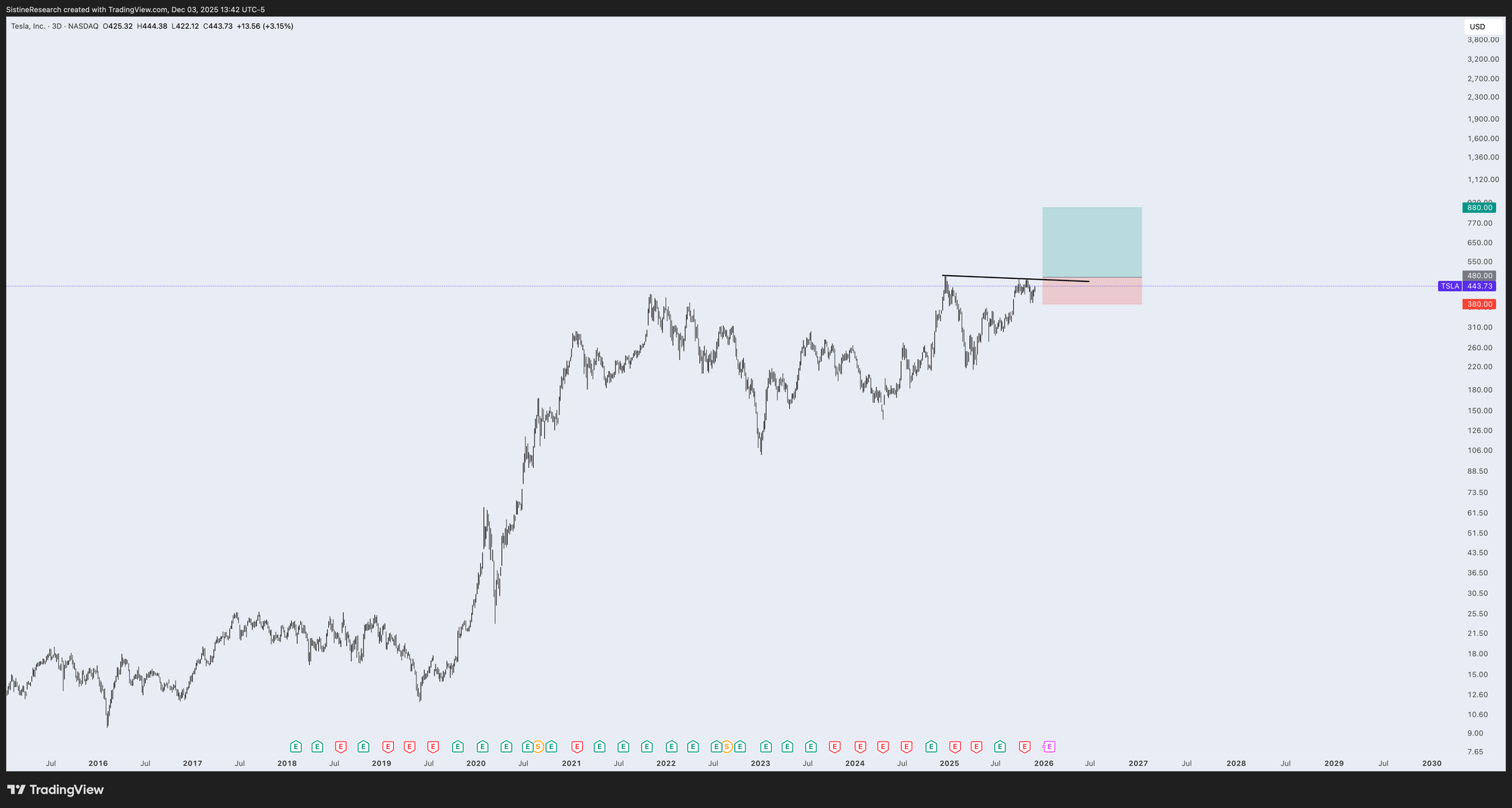
🏷️ Name: Tesla
💠 Ticker: $TSLA
📈 Direction: Long
🎯 Entry: $480
🎯 Target: $880 or trailing stop loss
🛑 Stop Loss: $380
⚖️ Risk / Reward: 4: 1
Investment Analysis: Tesla (TSLA) as a Robotics & AI Platform
Executive Summary
The investment thesis for Tesla (TSLA) has fundamentally shifted from a pure-play electric vehicle (EV) manufacturer to a diversified "physical AI" robotics platform. While short-term volatility remains tied to automotive margins and deliveries, the long-term "bull case" relies heavily on the successful commercialization of autonomous systems, specifically the Optimus humanoid robot. Analysts from firms like Ark Invest project that up to 90% of Tesla’s enterprise value and earnings by 2029 could stem from autonomous systems rather than traditional auto sales.
This report analyzes TSLA as a strategic long position for the emerging robotics industry, detailing the technological synergies, manufacturing advantages, financial projections, and competitive landscape that define its potential dominance.
1. Technological Synergy: The "Unified Brain" Advantage
Tesla's primary competitive moat in robotics is the direct transfer of its Full Self-Driving (FSD) technology to humanoid form factors. Unlike competitors building brains from scratch, Tesla is repurposing a mature, vision-based neural architecture.
- Unified AI Stack: Ashok Elluswamy, Tesla’s VP of AI Software, has confirmed that the neural networks driving Tesla cars are used in Optimus. "Photons go in, actions come out," covering both vehicle control and bipedal navigation.
- Neural World Simulator: Tesla utilizes a "neural world simulator" trained on fleet data to generate high-fidelity synthetic training environments. This allows Optimus to learn complex tasks and corner cases in simulation before real-world deployment, solving the data scarcity problem that plagues robotics.
- Inference Hardware: Optimus runs on the same inference chips designed for FSD computers. This vertical integration allows Tesla to optimize power-per-watt performance, critical for battery-operated mobile robots.
2. Production & Manufacturing Scale
While competitors like Figure AI and Agility Robotics rely on pilot programs, Tesla is actively building mass-manufacturing infrastructure. The company’s ability to scale hardware production is a distinct differentiator.
- Production Timeline:
- 2025: "Thousands" of units produced for internal use in Tesla factories (doing meaningful work).
- 2026: Scheduled transition to high-volume production for external customers.
- 2027+: A dedicated facility at Giga Texas is under construction with a design capacity targeting up to 10 million units annually in the long term.
- Cost Curve & BOM Analysis:
- Target Price: Tesla aims for a consumer price point of $20,000–$30,000.
- Current Reality vs. Future Scale: Estimates place the current Bill of Materials (BOM) for Optimus Gen 2 at approximately $50,000–$60,000. However, analysts project that localized manufacturing and scale could drive component costs down to ~$17,000 by 2030. Actuators currently account for ~50% of the cost, a component Tesla designs in-house to reduce reliance on expensive suppliers.
3. Financial Projections & Market Opportunity
Wall Street is beginning to model robotics as a material revenue driver rather than a science project.
- Valuation Impact: Morgan Stanley estimates the humanoid robot market could exceed $5 trillion, while Citi forecasts $7 trillion.
- Revenue Contribution:
- Gene Munster (Deepwater Asset Management) forecasts up to 40% of Tesla’s operating income could come from robotaxis and FSD licensing by 2030, a proxy for its autonomous AI value.
- In a bullish scenario, analysts project Tesla's 2030 revenue could reach nearly $1.94 trillion, driven significantly by high-margin AI and robotics revenue streams.
- Elon Musk has stated that Optimus could eventually account for the majority of Tesla's long-term value.
4. Competitive Benchmarking
Tesla faces credible competition but holds advantages in vertical integration and mass manufacturing capability.
| Feature | Tesla Optimus Gen 2 | Figure 02 (Figure AI) | Digit (Agility Robotics) |
|---|---|---|---|
| Primary Strength | Mass scale manufacturing & FSD Brain | AI Reasoning (OpenAI partnership) | Logistics/Warehouse reliability |
| Status | Internal Pilot / Pre-mass production | BMW Pilot deployment | Commercial deployment (Amazon/GXO) |
| Est. Price | $20k - $30k (Target) | $120k - $150k (Est.) | ~$250k (Est.) |
| Hands | 11 DoF (Gen 2), 22 DoF (Gen 3) | 16 DoF | End-effectors (Clamps) |
| Compute | Proprietary Tesla Silicon | 3x compute vs Gen 1 | Standard Industrial |
Competitive Insight: While Figure 02 and Digit have beaten Tesla to third-party commercial pilots (BMW and Amazon, respectively), Tesla's strategy focuses on internal validation first. Optimus is being deployed to replace labor within Tesla’s own Gigafactories, creating an immediate feedback loop and cost-saving mechanism before external sales begin.
5. Risks & Regulatory Headwinds
Investors must weigh the "hardware-rich" valuation against significant regulatory hurdles.
- Safety Standards: New standards (e.g., ISO 25785) are being drafted to address "actively controlled stability" (balance) for humanoids. Unlike caged industrial robots, humanoids introduce tip-over risks that regulators are aggressively targeting.
- Liability: The EU's 2025 AI Act and new product liability directives may impose strict liability for autonomous decisions made by robots, potentially slowing deployment in Europe compared to the US or China.
Conclusion
For investors with a multi-year horizon, TSLA offers a unique "call option" on the robotics industry. It is the only company combining state-of-the-art AI inference, proprietary actuation hardware, and global mass-manufacturing infrastructure under one roof.
While current valuation multiples (P/E > 80) are difficult to justify based on auto sales alone, the successful execution of the Optimus program—targeting a $20k price point and millions of units annually—would fundamentally re-rate the stock as an AI industrial monopoly. The expansion of Giga Texas for robotics suggests management is fully committed to this pivot.