Trade Idea: $XRP and $ETH


🏷️ Name: Ripple and Ethereum
💠 Ticker: $XRP and $ETH
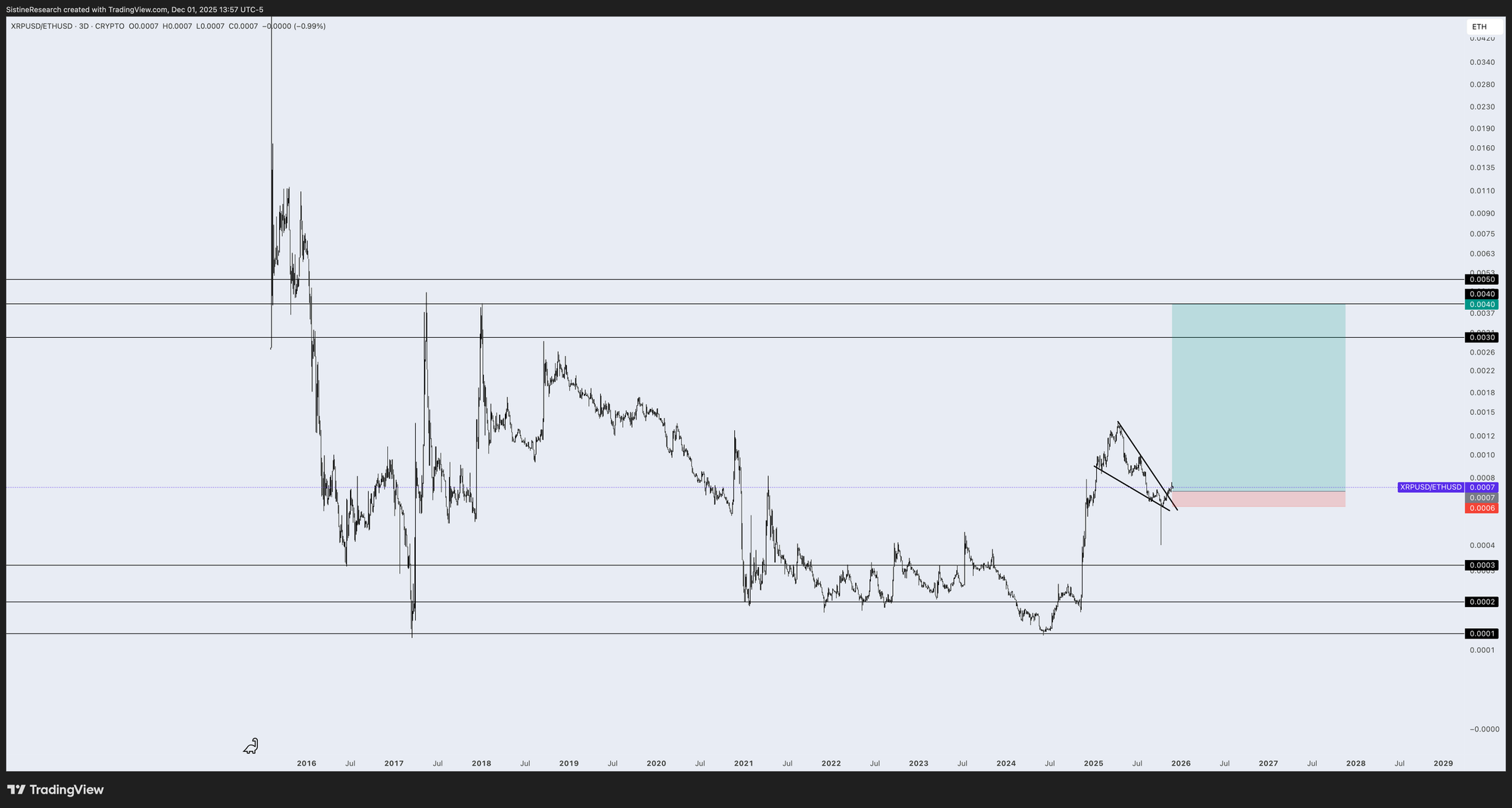
📈 Direction: Pair Trade: Long XRP, Short ETH
🎯 Entry: ~0.0007
🎯 Target: 0.0040 or trailing stop
🛑 Stop Loss: <0.0006
⚖️ Risk / Reward: 33 : 1
🌎 Exchange: Hyperliquid or Bybit
Executive Summary
A Long XRP / Short ETH pair trade to capitalizes on a massive divergence in fundamental momentum. While Ethereum (ETH) suffers from structural degradation in its monetary policy and revenue model post-Dencun, XRP has entered a "super-cycle" of institutional adoption driven by ETF launches, the RLUSD stablecoin, and final regulatory clarity. With the XRP/ETH ratio trading near multi-year lows (~0.0006) and ETH borrow costs stabilizing below 1%, this trade offers high asymmetric upside with a low cost of carry.
Core Thesis 1: The Institutional "Flip" – ETF Momentum vs. Stagnation
The primary driver for the long leg is the aggressive institutional onboarding of XRP, which contrasts sharply with the mature, saturated narrative of Ethereum.
- XRP ETF Launches (Immediate Catalyst): The U.S. market is witnessing a synchronized launch of spot XRP ETFs. Canary Capital’s ETF (XRPC) launched on November 13, 2025, shattering records with $58 million in Day 1 volume—the highest of any 2025 ETF debut. Following this, the 21Shares XRP ETF (TOXR) begins trading today, December 1, 2025, on the Cboe BZX Exchange.
- Supply Shock: Institutional vehicles are rapidly locking up supply. In just the first two weeks of trading, XRP ETFs accumulated over $666 million in inflows.
- Regulatory Resolution: The catalyst for these products was the dismissal of all appeals in the SEC vs. Ripple lawsuit on August 7, 2025, which cemented XRP’s non-security status and removed the regulatory overhang that had suppressed price for five years.
Core Thesis 2: Ethereum’s Broken Economics (The Short Leg)
Ethereum’s fundamentals have deteriorated following the March 2024 "Dencun" upgrade, which prioritized L2 scaling at the expense of L1 economics.
- Return to Inflation: The "Ultrasound Money" narrative has failed. Post-Dencun, the massive reduction in L1 fees led to a collapse in the burn rate. As of late 2025, ETH supply has climbed back to pre-Merge levels, effectively negating years of deflationary pressure.
- Revenue Collapse: Ethereum’s Layer 1 revenue has plummeted by ~99%, falling from a peak of $35.5 million in March 2024 to roughly $578,000 by September 2024, a trend that has persisted into late 2025. L2 solutions like Base and Arbitrum are parasitic, siphoning execution revenue while paying minimal "rent" for blobs.
- Cannibalization: Activity has migrated to L2s that do not require holding ETH for gas in significant quantities, reducing structural demand for the native token.
Fundamental Catalyst: The RLUSD Liquidity Engine
Distinct from Ethereum's revenue drain, Ripple is launching a major utility driver that directly benefits the XRP Ledger (XRPL).
- Launch Date: Ripple’s enterprise-grade stablecoin, RLUSD, launched globally on December 17, 2024.
- Economic Impact: Unlike ERC-20 stablecoins that congest Ethereum, RLUSD is designed to deepen liquidity on the XRPL for institutional cross-border settlement. It will be available on major platforms like Uphold, Bitso, and MoonPay. This creates a new fundamental demand vector for XRP as a bridge asset, independent of speculative flows.
Conclusion
The Long XRP / Short ETH trade captures the defining rotation of the 2025 cycle: capital moving from "legacy" smart contract platforms facing inflationary decay (ETH) to regulated, utility-driven assets entering their institutional prime (XRP).
- Invalidation: A reversal in Ethereum's fee revenue mechanics or a rejection of remaining XRP ETF applications (unlikely given Aug 2025 legal victory).
We project XRP to outperform ETH by 50–100% over the next quarter as ETF inflows accelerate and Ethereum's supply continues to inflate.